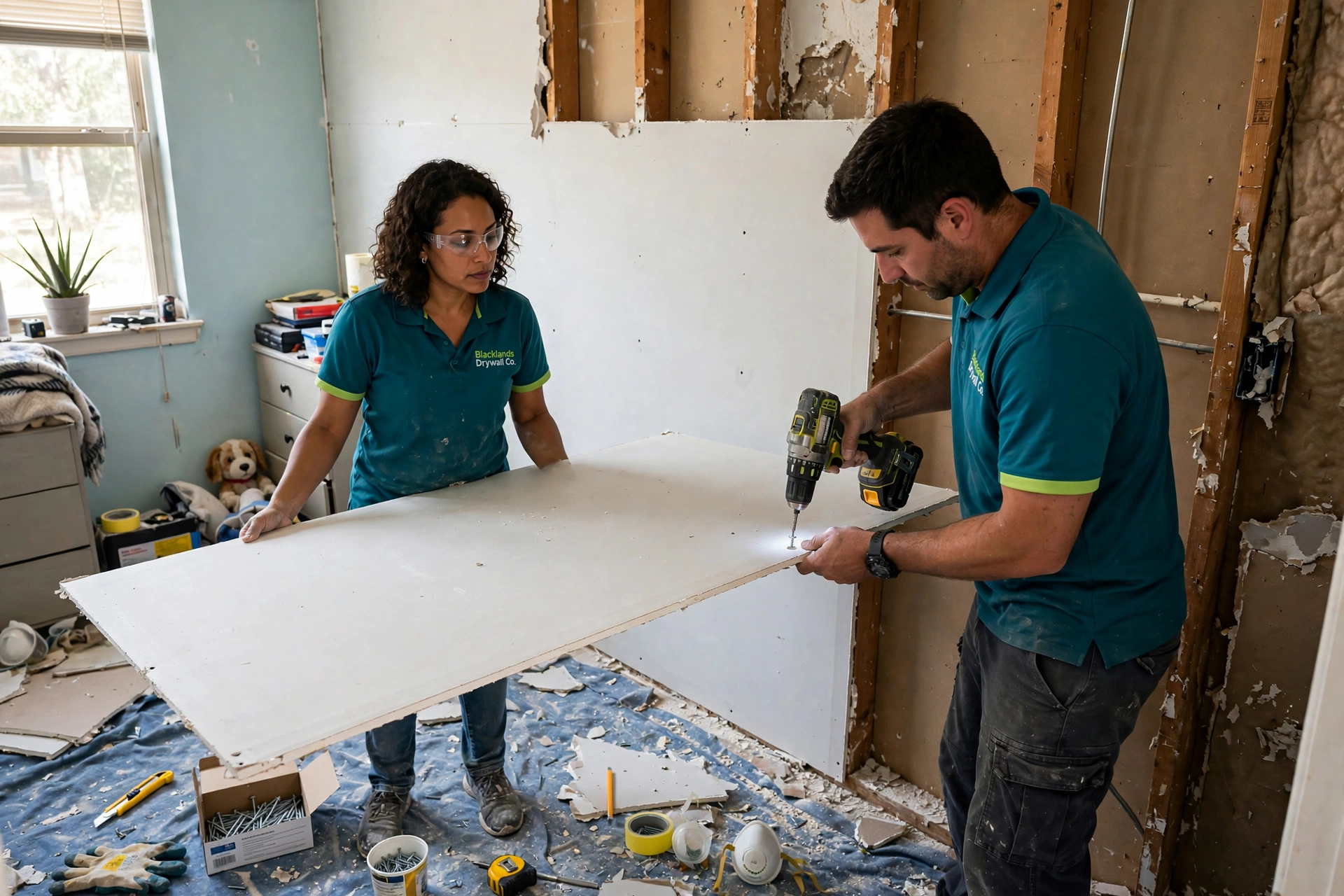
The short answer: when a pipe bursts during a Texas freeze, shut off your home's main water immediately, then call for help - the drywall damage spreads fast because burst pipes release large volumes of clean water quickly. The good news: burst-pipe water is clean water, which gives your drywall the best chance of being saved if you act within the first day or two. Document everything with photos for insurance (burst pipes are typically covered), don't paint over anything, and get a professional moisture assessment before deciding what stays and what goes. Call Blacklands Drywall Co. at (214) 494-8955 - we handle freeze burst-pipe drywall damage across Rockwall.
Why Texas Freezes Are Uniquely Brutal on Pipes (and Drywall)
Texas homes weren't built for sustained hard freezes. Pipes run through exterior walls, attics, and crawl spaces with minimal insulation by northern standards - because for decades, that was enough. Then February 2021 showed what happens when it isn't: days of subfreezing temperatures burst pipes across the state, and the drywall damage that followed kept contractors busy for months.
The physics is simple: water expands when it freezes. Ice forms a blockage, pressure builds between the blockage and the closed faucet, and the pipe splits - often not where the ice is, but downstream where pressure peaks. When the ice thaws, water pours through the split at full line pressure. A burst 3/4-inch supply line can release gallons per minute. Overnight, that's hundreds of gallons inside your walls.
Hard freezes still hit North Texas. Every winter brings at least a scare, and every scare bursts pipes somewhere in Rockwall County. If you're reading this with water running down a wall right now, skip to the emergency steps. If you're reading it in October, read the prevention section at the end - future you will be grateful.
The First Hour: Emergency Steps in Order
- Shut off the main water. Find your main shutoff valve now - usually near the water meter, in the garage, or where the line enters the house. Turn it clockwise until it stops. This is the single most important action; everything else is secondary. If you don't know where your shutoff is, find out today, before the next freeze.
- Turn off electricity to affected areas if water is near outlets, switches, or the breaker panel. Water and electricity are the one combination worse than water and drywall. If in doubt, kill the breaker for the wet rooms.
- Document everything. Photos and video of the active leak, the water's path, every stained or wet surface, and the burst pipe itself if accessible. Your insurance claim starts here - adjusters want to see the damage as found, not after cleanup.
- Start removing standing water - towels, mops, wet vacuum. You're not drying the walls yet; you're just stopping the spread and protecting floors and belongings.
- Call for professional assessment. Burst-pipe drywall damage looks simple ("a wet wall") but the water travels inside cavities in ways you can't see. Early professional assessment - ideally within the first day - determines whether you're drying or replacing, and that decision gets more expensive every day you wait.
- Call your insurance company to open a claim. Burst pipes are the textbook "sudden and accidental" event that homeowners policies typically cover. More on this below and in our full insurance claims guide.
What NOT to do in the first hour: don't try to repair the pipe yourself unless you know plumbing (a bad repair just re-floods), don't poke holes in walls to "drain" them (you'll hit wiring or spread water), and don't turn the water back on to "test" anything.
Why Burst-Pipe Drywall Damage Is Different
Not all water damage behaves the same, and burst pipes have a specific profile:
It's clean water. Supply-line water is the best-case category - no contaminants, which means drying and salvaging drywall is genuinely on the table. This is the silver lining of a burst pipe versus, say, a sewer backup.
It's high volume, fast. Unlike a slow AC drip that wets one spot over weeks, a burst pipe soaks large areas in hours. Walls, ceilings below, insulation, baseboards - the damage footprint is wide. That width is what makes professional moisture mapping essential: the visible wet area is never the full wet area.
It hits while it's freezing. The house is cold, the air is cold, and drying conditions are poor until heat is restored. Cold slows evaporation, which stretches the timeline - another reason professional dehumidification matters more here, not less.
It often affects multiple rooms. Water follows gravity and framing - down wall cavities, across ceiling planes, into rooms below the burst. A pipe that bursts in an upstairs bathroom wall can damage the bathroom, the hallway below, and the living room ceiling. Expect the scope to surprise you; that's normal.
The Drywall Damage Pattern to Expect
After a burst pipe, here's what professionals typically find:
- Walls: the bottom 2–4 feet of drywall along the burst wall and adjacent walls, soaked from wicking. Baseboards swollen or pulling away. This is classic flood-cut territory - remove the damaged lower section, keep the healthy upper wall.
- Ceilings below: if the burst was upstairs, the ceiling below shows stains first, then sagging if saturation is heavy. Sagging ceiling drywall after a burst pipe is common and needs prompt professional removal - it's heavy and dangerous.
- Insulation: wet insulation behind the drywall almost always needs removal. It holds water against framing and drywall, prevents drying, and feeds mold. Budget for it in every burst-pipe job.
- Cabinets and built-ins: vanities, kitchen cabinets, and built-in shelving trap water behind and beneath them. These areas hide the worst damage and need careful inspection.
The pattern to internalize: burst-pipe damage is wide but shallow in time - a lot of area, wetted quickly, with clean water. That combination responds well to fast professional response and poorly to waiting.
Dry It or Replace It? The Burst-Pipe Decision
Because burst-pipe water is clean, the "dry it" option stays viable longer than with contaminated water - but volume and time still decide:
Likely dryable: drywall that's still firm, discovered within a day or two, with the source stopped and professional drying started promptly. Our articles on how to tell if drywall needs replacement and how long drying takes cover the tests and timelines.
Likely replacement: drywall that's soft or crumbling, ceilings that sag, any section wet for many days (common when bursts happen in vacant homes or wall cavities during the 2021-style multi-day outages), and anywhere mold has established.
The typical burst-pipe job: flood cuts along affected walls, ceiling section replacement where sagging occurred, insulation replacement throughout the wet cavities, then full refinishing - texture matching and paint. It's a multi-step job, but it's a well-understood one. Burst-pipe drywall repair is routine work for a specialist; the key variable is always how fast the response started.
Insurance: Burst Pipes Are Usually Covered
This is the rare water-damage scenario where insurance is straightforward:
- Burst pipes are the classic "sudden and accidental" event. Standard homeowners policies typically cover the resulting water damage - drywall, ceilings, flooring, and belongings affected.
- Your deductible applies. You pay the deductible; insurance covers the rest up to policy limits.
- Document before cleanup. Photos of the burst pipe, the water's path, and all damage - taken before repairs start - are what adjusters need.
- Mitigate anyway. Insurers expect you to stop the water and prevent further damage (shutoff, water removal, emergency drying). Don't wait for the adjuster to start emergency response.
- The pipe repair itself may or may not be covered depending on the policy - but the resulting water damage to your drywall and home typically is.
One caution: if the burst resulted from negligence the insurer can point to - like leaving a home unheated with the water on during a known freeze - coverage disputes happen. That's an edge case, not the norm, but it's worth knowing. Our [insurance claim repair page](/services/insurance-claim-repair/) covers documentation in detail.
What the Repair Process Looks Like
Once the water is stopped and the claim is opened:
- Moisture mapping. Meters define the full wet area - expect it to be bigger than the visible damage.
- Emergency mitigation. Standing water out, saturated materials stabilized, drying equipment placed.
- The dry/remove/replace decision, made with meter readings and firmness tests - explained to you in plain words before work starts.
- Removal where needed. Flood cuts, ceiling sections, wet insulation - clean lines, contained debris.
- Drying verification. Cavities and framing verified dry with readings before anything closes up.
- Rebuild. New drywall, taping, mudding, texture matching, prime, paint.
- Final walkthrough. You inspect the work with the contractor before sign-off.
Timeline: a typical burst-pipe drywall job runs one to two weeks from assessment to final paint, with drying and mudding each needing their own curing time. Anyone promising it all in two days is skipping steps.
Preventing the Next One (Rockwall Winter Checklist)
Future freezes are a when, not an if. Before the next hard freeze:
- Know your main shutoff location and make sure everyone in the house knows it too.
- Insulate exposed pipes - especially in attics, crawl spaces, garages, and exterior walls. Foam sleeves are cheap; burst pipes aren't.
- Drip faucets on exterior walls during hard freezes - moving water resists freezing.
- Open cabinet doors under sinks on exterior walls to let warm air reach the pipes.
- Don't set the thermostat below 55°F if leaving home during winter, even for a weekend.
- Disconnect outdoor hoses and shut off exterior faucets - frozen hose bibs burst inside the wall.
None of this helps mid-crisis, but the cheapest burst-pipe drywall repair is the one that never happens.
Bottom line: A burst pipe during a Texas freeze is a race against two clocks: the mold clock (48 hours) and the deterioration clock (every day wet drywall gets weaker). Shut the water off, document everything, and get professional eyes on it fast - because burst-pipe water is clean, speed is genuinely the difference between drying and replacing.