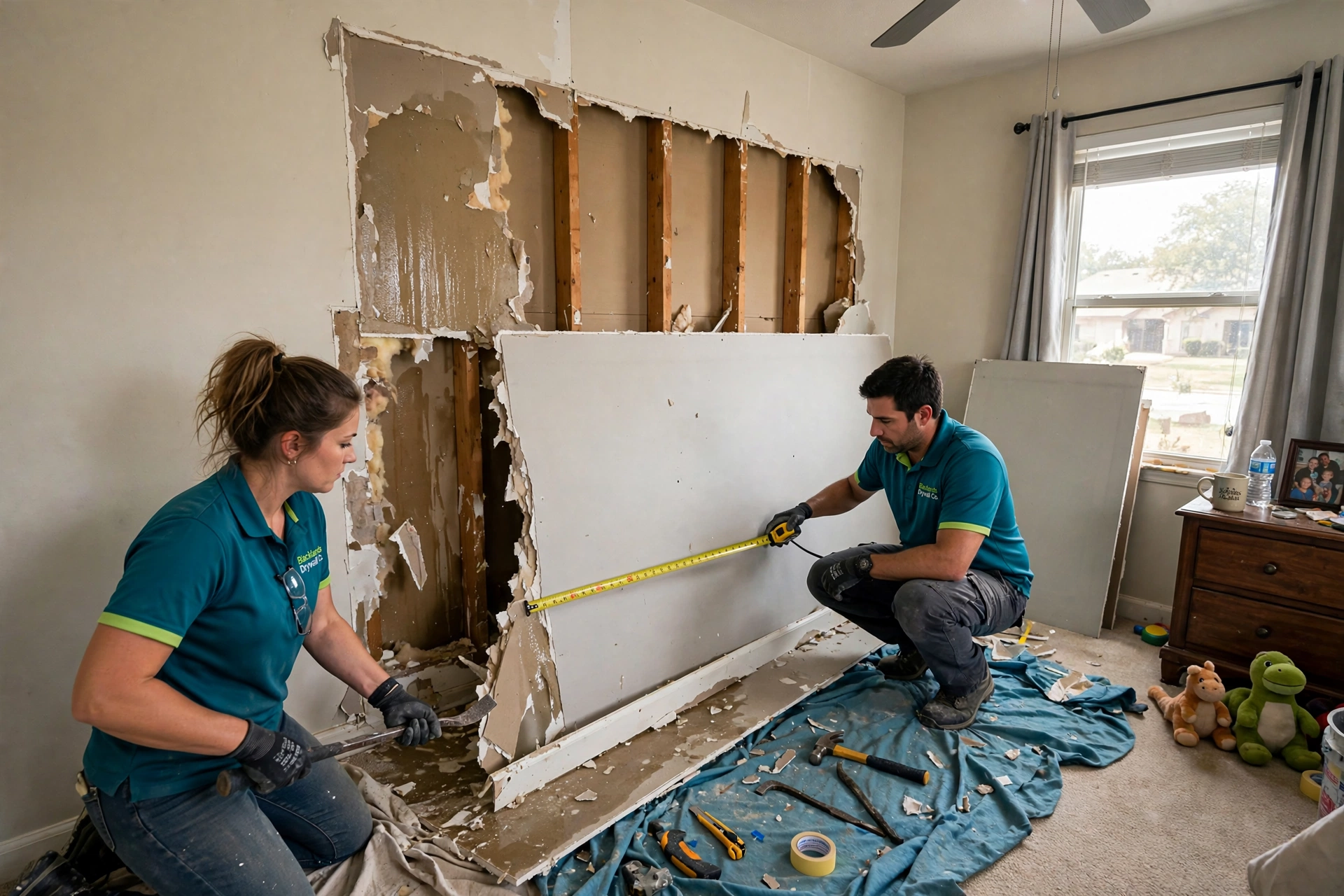
The short answer: the size of the visible stain is not the same as the size of the repair. A patch covers an isolated area of damage with clean, stable edges on all sides; a full sheet (or flood cut) replacement happens when the wet area is too extensive, too close to a seam, or too structurally compromised for a patch to make sense. The decision comes from moisture meter readings and firmness checks - not from eyeballing the stain. Call Blacklands Drywall Co. at (214) 494-8955 for an assessment that tells you which one your wall actually needs.
Why "Just Patch the Stain" Isn't Always the Right Answer
It's a reasonable instinct: the stain is six inches across, so the repair should be about six inches across. But drywall damage from water doesn't respect the boundary of the visible stain. Water wicks sideways through the paper facing and gypsum core, often extending a foot or more beyond where discoloration is visible to the eye. A patch sized to the stain alone can leave compromised, still-weak material just outside the repair - material that looks fine today and causes a callback in six months.
This is why professional assessment starts with a moisture meter, not a tape measure around the stain. The meter maps the actual wet boundary, which is almost always larger than what you can see.
When a Patch Is the Right Call
A patch - cutting out and replacing a defined section of drywall, surrounded by sound material - makes sense when:
- Moisture mapping confirms the wet area is genuinely contained and doesn't extend to panel edges or framing seams.
- The surrounding drywall tests dry and firm on all sides of the cut line, with meter readings matching the dry reference standard.
- The damage is mid-panel, away from the edges where the sheet meets another sheet or meets a corner - patches work best when there's solid material on all four sides to tie into.
- There's no sign of insulation or framing involvement behind the damaged section.
A well-executed patch - cut cleanly, taped, mudded in multiple coats, texture-matched - can be essentially invisible and is the more economical option when the damage genuinely is contained.
When a Full Sheet or Flood Cut Is the Right Call
Replacing a full sheet, or performing a flood cut (removing a horizontal band of drywall, typically 2 feet up from the floor, across an entire wall or room), makes sense when:
- The wet area extends to or across a seam. Patching up to a seam rarely holds as well as replacing to the seam, since the existing seam tape is often also compromised by the same moisture.
- Water damage runs along the bottom of a wall from flooding or a burst pipe, which is the classic flood-cut scenario - water pools at the floor and wicks upward fairly uniformly across the whole wall, so cutting a continuous band at a consistent height (above the highest point of wicking, confirmed by the meter) addresses the whole affected zone at once rather than patch-working six separate small repairs.
- Moisture mapping shows the wet zone is large relative to the panel, at which point multiple small patches end up costing more in labor and still risk gaps between repairs than one clean full-sheet replacement.
- The drywall is soft, crumbling, or failing a firmness test across a wide area - compromised material needs to come out, and patching around compromised edges doesn't hold.
- Mold is present or suspected in a wider area than a small patch would address - the affected material needs full removal, not partial.
How the Flood Cut Specifically Works
For water that's pooled at floor level - burst pipes, flooding, major appliance failures - the flood cut is the standard professional approach:
- Moisture mapping determines the highest point the water wicked to, often measured at multiple points across the wall since wicking height varies.
- A cut line is set a few inches above the highest wet reading, for margin, typically landing in the 2-foot-up range for moderate events but adjusted per the actual readings.
- The drywall below that line is removed across the full affected wall (or room), along with any wet insulation behind it.
- The exposed stud cavity and insulation are assessed and dried or replaced as needed before the wall closes back up.
- New drywall is installed in the band, taped, mudded, and the baseboard is reinstalled (or replaced, if it was also damaged - see our guide on [water damage below baseboards](/blog/water-damage-baseboards-bottom-edge-drywall)).
The flood cut looks more dramatic than a small patch - more wall comes out - but it's actually the more thorough and often more cost-effective approach for this specific damage pattern, because it addresses the entire affected zone in one consistent operation instead of multiple disconnected patches.
The Cost Comparison, Honestly
Patches are cheaper per job when they're the right call - less material, less labor, less finishing area. But a patch that was sized too small because it followed the visible stain instead of the moisture reading often ends up costing more in total: the first patch, then a callback when the hidden compromised material fails later, then a second repair that's now bigger than the first patch would have needed to be if done right the first time.
Full sheet or flood cut replacement costs more upfront but addresses the complete affected area in one pass. When moisture mapping shows the damage genuinely warrants it, this is usually the more economical path across the life of the repair, not just the more thorough-looking one.
Our [drywall water damage cost guide](/blog/water-damaged-drywall-repair-cost-rockwall) breaks down pricing factors in more detail, including how patch size, flood cuts, and ceiling work each affect the estimate.
What a Proper Assessment Looks Like
When we assess water-damaged drywall for a patch-or-replace decision, the process is:
- Visual inspection of the stain, sag, or visible damage.
- Moisture meter readings at multiple points, extending well past the visible damage, to map the true wet boundary.
- Firmness testing across the mapped area to identify any soft or structurally compromised sections.
- Comparison against seam and edge locations - is the wet zone contained mid-panel, or does it reach a seam, corner, or floor line?
- A clear recommendation - patch or replacement - explained with the actual readings, not just a verbal assurance.
If a contractor tells you "it's a patch job" without ever pulling out a moisture meter, ask what the assessment was based on. The honest answer should involve measurement, not a glance.
Bottom line: The right repair size is decided by where the water actually went, not by where the stain happens to show. A proper moisture-mapped assessment sometimes confirms a small patch is enough - and sometimes reveals that a bigger, more thorough replacement is what actually prevents a second repair down the line.