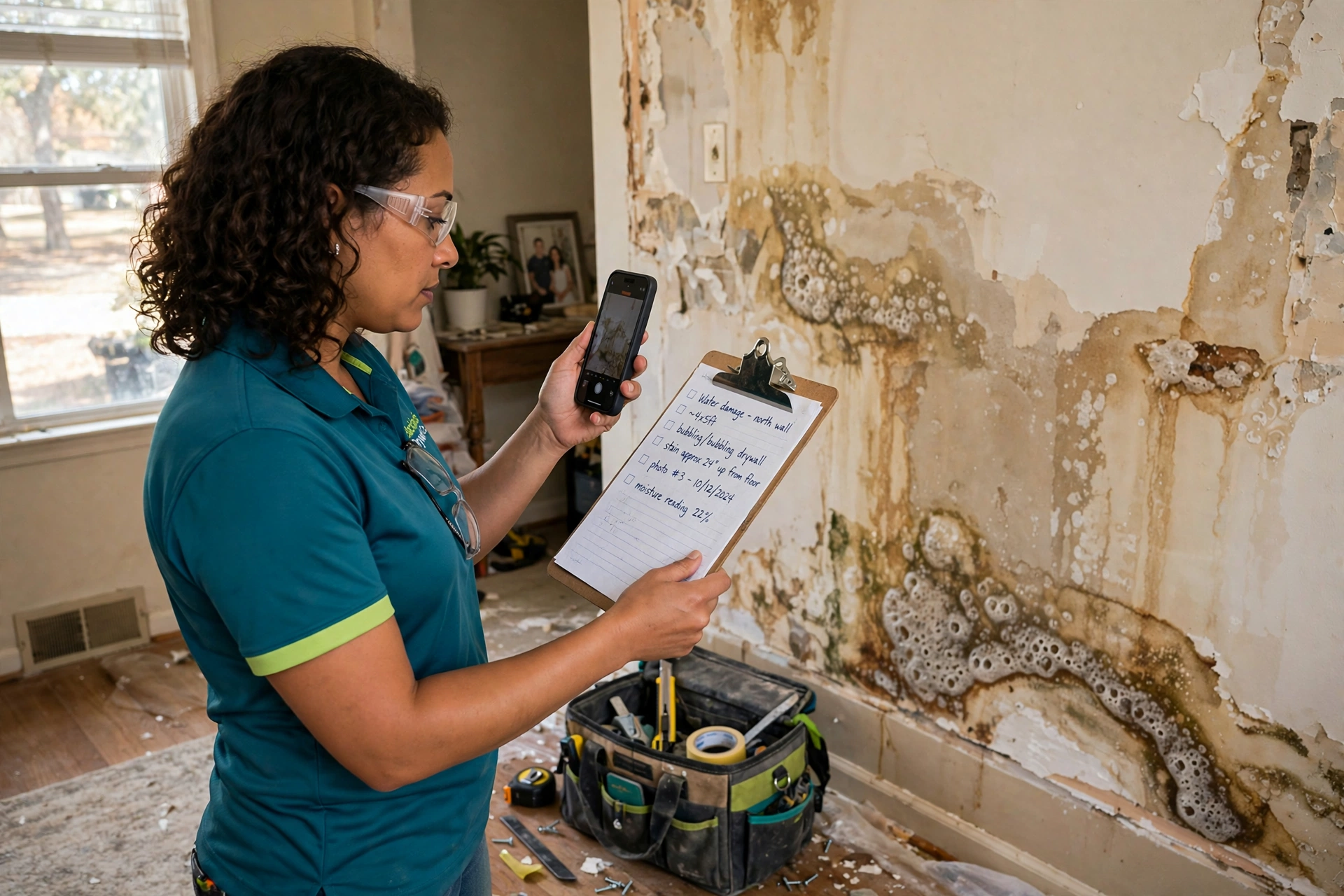
The short answer: most sudden water events - burst pipes, appliance supply-line failures, storm-driven roof leaks - are typically covered by standard homeowners insurance, minus your deductible. Slow leaks and outside floodwater usually aren't. The claims that get paid smoothly share one thing: thorough documentation from hour one. This guide walks the entire process chronologically - from discovery to final payout - with drywall-specific documentation tips most guides miss. For help documenting your damage in Rockwall, call Blacklands Drywall Co. at (214) 494-8955.
Note: this is practical guidance from a drywall contractor's perspective, not legal or financial advice. Every policy differs - read yours and talk to your agent about specifics.
Phase 1: The First 24 Hours - Document and Mitigate
Everything about your claim's outcome is shaped in the first day. Two duties start immediately:
Your duty to document. Before anything is cleaned, dried, or repaired, capture the damage as found:
- Wide photos of every affected room, then close-ups of each damaged area
- The water source itself (the burst pipe, the leaking appliance connection, the roof area if safely visible)
- The water's path - where it traveled, including rooms that "just got a little wet"
- Video walkthrough with narration - date-stamped if your phone does it
- Keep damaged materials' photos even after removal begins; photograph each stage
For drywall specifically, the photos that matter most to adjusters: the full extent of staining, any sagging or bubbling, baseboards pulling away, and - critically - photos taken during professional assessment showing moisture meter readings and the marked cut lines. A contractor's moisture map is documentation gold: it proves the scope is measured, not guessed.
Your duty to mitigate. Insurance policies require you to prevent further damage - and "I was waiting for the adjuster" is not a defense for letting water sit. Shut off the source, remove standing water, and get emergency drying started. Keep receipts for every emergency expense (water extraction, emergency board-up, equipment rental) - these are typically reimbursable under the claim.
What NOT to do in phase 1: don't throw away damaged materials before photographing them, don't make permanent repairs before the adjuster sees the damage (emergency mitigation is expected; full rebuild is not), and don't post about it on social media (adjusters do look, and casual posts get misread).
Phase 2: Filing the Claim
Call your insurer's claims line (not your agent's office line - the dedicated claims number) and have ready:
- Your policy number
- Date and approximate time you discovered the damage
- What happened, in plain factual terms ("supply line to the upstairs bathroom burst" - not theories about why)
- What's damaged (rooms, drywall, ceilings, flooring, belongings - a preliminary list is fine)
- What emergency steps you've taken
What to say: facts. What happened, when you found it, what you've done since.
What not to say: don't speculate about causes ("I think the pipe was old"), don't minimize ("it's not that bad"), don't exaggerate, and don't admit fault or negligence ("I knew that pipe looked rusty"). Stick to observable facts. You're reporting, not arguing a case - the facts argue it.
Get a claim number and the adjuster's name and contact info. Ask about: your deductible amount, whether you have additional living expenses (ALE) coverage if rooms are unusable, and the expected timeline for adjuster contact. Write it all down.
What's Typically Covered (and What Isn't)
Standard homeowners policies (HO-3, the most common type) typically cover sudden and accidental water damage:
Usually covered:
- Burst pipes (including freeze bursts)
- Appliance supply-line failures (washing machine hoses, ice-maker lines, water heater supply)
- Sudden roof leaks from storm damage
- Accidental overflows (tub left running is the classic example)
Usually NOT covered:
- Gradual damage - slow leaks over weeks or months. Insurers classify these as maintenance failures. That AC drain line that's been dripping for two months? Likely denied.
- Floodwater from outside - rising water, storm surge, overflowing bodies of water. This needs separate flood insurance, full stop.
- Sewer backup - unless you carry a specific water/sewer backup endorsement.
- Neglect - damage the insurer can tie to failure to maintain (unheated home during a freeze with water left on, known leaks ignored).
- Mold - many policies cap mold coverage at a sublimit (often $5,000–$10,000) or exclude it beyond the initial water event. Check your policy's mold language specifically.
The gray zone: "Was it sudden?" is where most drywall claims live or die. A pipe that burst yesterday is sudden. A pipe that's been seeping inside a wall for six months is gradual - even if you just discovered it. Honest timeline matters: if you genuinely didn't know, say so, but don't invent a sudden story for a gradual problem. Adjusters investigate, and misrepresentation can void a claim entirely.
Phase 3: The Adjuster Visit
The adjuster inspects, documents, and determines what the insurer will pay for. How you handle this visit significantly affects the outcome:
Before the visit:
- Have your photo/video documentation organized and ready to share
- List all damaged areas room by room - including ones the adjuster might miss (closets, areas behind furniture)
- If you've had a contractor assess the damage, have their written scope/estimate ready
- Be present for the inspection. This matters more than people think.
During the visit:
- Walk the adjuster through every damaged area yourself. Don't assume they'll find everything - they won't open closets or move furniture unless asked.
- Point out the moisture mapping if a contractor did one. Measured scope (meter readings, marked boundaries) is far more persuasive than "the wall feels wet."
- Answer questions factually. Don't volunteer theories, don't argue, don't negotiate on the spot - the adjuster's job is documentation, not settlement.
- Ask what happens next: timeline for the estimate, how supplements work if more damage is found during repairs.
The contractor's role: having your drywall contractor present (or their written assessment in hand) helps enormously. Contractors speak the adjuster's language - square footage, material quantities, line-item scopes - and can point out damage an adjuster might under-scope, like wet insulation behind drywall or the full extent of a ceiling plane. This isn't adversarial; it's completeness. The best outcomes happen when contractor and adjuster agree on scope.
Phase 4: Estimates, Scopes, and Supplements
After the visit, the insurer produces an estimate - their calculation of what the repair should cost. Here's what to know:
The insurer's estimate vs. your contractor's estimate will differ. Insurers use standardized pricing software (Xactimate is the industry standard); contractors price from their actual costs. Some difference is normal. Large differences need resolution before work starts.
Supplements are the mechanism for that resolution. When demolition reveals more damage than the adjuster saw - wet insulation behind the drywall, a larger affected area, mold in the cavity - your contractor documents it and submits a supplement: additional scope with photos and justification. Supplements are routine and expected in water-damage work; a job with zero supplements is rarer than one with three.
What if you disagree with the settlement? You can: provide contractor documentation supporting a higher scope, request re-inspection, invoke your policy's appraisal clause (a formal dispute process), or consult a public adjuster (who works for you, for a percentage). Most disagreements resolve at the supplement stage without escalation.
Choosing your contractor: your insurer may suggest "preferred" contractors. You are not obligated to use them - you have the right to choose your own licensed contractor. Choose based on competence with water-damaged drywall specifically, not on who the insurer prefers.
Phase 5: Approval, Repairs, and Getting Paid
How payment typically works: for most claims, the insurer issues payment (minus your deductible) based on the agreed scope. Many policies pay actual cash value first, then release recoverable depreciation after repairs are completed and invoiced - meaning you may need to front costs or arrange contractor billing accordingly. Ask your adjuster exactly how your policy pays before work starts.
During repairs: your contractor should document everything - daily photos, moisture readings proving drying, material invoices. This protects both of you if supplements are needed.
After completion: final walkthrough with your contractor, final invoice submitted to the insurer, depreciation released (if applicable), claim closed. Keep all claim paperwork for at least a few years - if related issues surface later, the paper trail matters.
The Deductible Math: When Filing Makes Sense
Not every water-damage job should go through insurance:
- Repair cost well below your deductible: don't file. A $600 patch against a $2,500 deductible means you pay everything anyway - plus you've created a claim on your record.
- Repair cost moderately above deductible: the classic judgment call. Weigh the net payout against potential premium effects and your claims history.
- Major damage (multi-room, ceilings, flood cuts): almost always worth filing. This is what insurance is for.
- Multiple claims in a few years: insurers track frequency. Two water claims in three years draws more scrutiny than one in ten. Factor your history into the decision.
There's no universal right answer - it's arithmetic plus judgment. What you shouldn't do is file small claims reflexively; the claim record outlasts the payout.
Common Denial Reasons (and How to Avoid Them)
- Gradual damage exclusion. The number-one drywall claim killer. Avoid it by fixing leaks promptly and documenting discovery honestly.
- Flood exclusion. Outside water needs flood insurance. Know the difference before you need it.
- Late reporting. Report promptly after discovery. Delays invite questions about mitigation and timeline.
- Insufficient documentation. "Trust me, it was worse" doesn't work. Photos, meter readings, contractor scope - the paper wins.
- Pre-existing damage. If the adjuster finds evidence the damage predates the claimed event (old stains, prior repairs), expect scrutiny. Honest history beats discovered history.
- Policy exclusions you didn't know about. Mold sublimits, sewer backup without endorsement, earth movement. Read your policy before you need it, not after.
Bottom line: Insurance claims for water-damaged drywall succeed on documentation and fail on delay. Photograph everything immediately, mitigate without waiting, report promptly, walk the adjuster through every damaged area, and let your contractor's measured scope do the talking. The process has five phases - document, file, inspect, scope, repair - and homeowners who work all five deliberately get paid fairly.