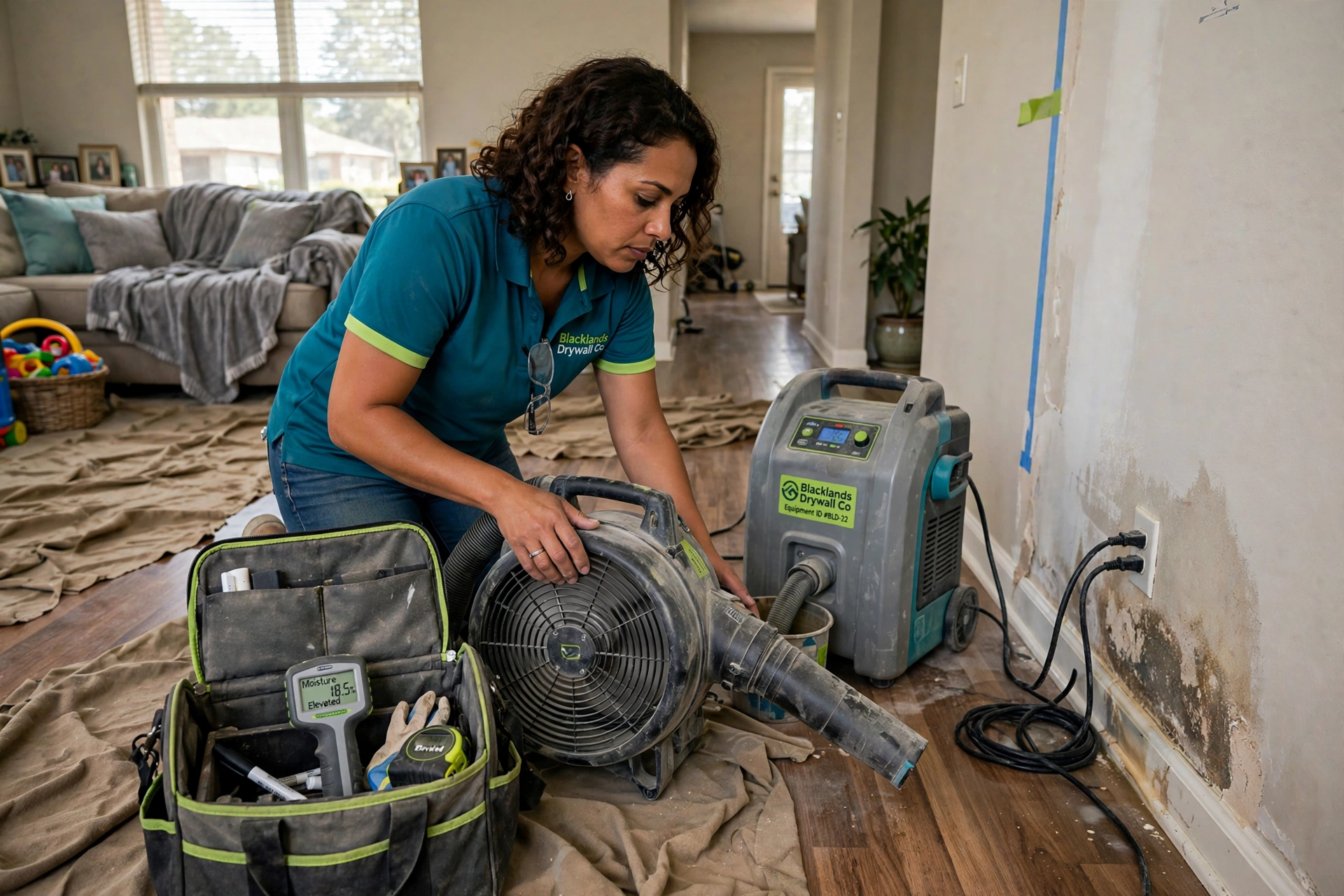
The short answer: surface-dry in hours, truly dry in days. Lightly damp drywall can dry in 2–3 days with professional equipment; moderately soaked walls typically need 3–5 days; severely saturated walls or wall cavities with wet insulation can take a week or more. A box fan and an afternoon won't do it - real drying means dehumidification plus moisture-meter verification. And the timeline matters: widely published guidance notes mold can begin growing within 24–48 hours, so every day of slow drying is a day of growing risk. Call Blacklands Drywall Co. at (214) 494-8955 - we'll measure your walls and tell you exactly where you stand.
Why "How Long" Has No Single Answer
Ask five contractors how long wet drywall takes to dry and you'll get five answers - because they're picturing five different situations. Drying time isn't a property of drywall; it's the result of six variables interacting:
- How saturated it is. Damp surface vs. soaked-through core are different jobs. A splash dries fast; a wall that wicked water up two feet doesn't.
- Wall vs. ceiling vs. cavity. Exposed drywall dries faster than drywall inside a closed wall cavity, which has no airflow by design. Ceilings dry slower than walls - warm moist air gets trapped above.
- What's behind it. Wet insulation is a moisture reservoir that keeps re-wetting the drywall from behind. Framing lumber holds water too. Drying the surface while the cavity stays wet is running in place.
- Temperature and humidity. Warm, dry air pulls moisture out; cool, humid air doesn't. This is why the same leak dries faster in winter (heated indoor air) than in a humid Texas summer - and why lakeside Rockwall homes near Lake Ray Hubbard dry slower than you'd expect.
- Equipment. Professional air movers plus refrigerant dehumidifiers vs. a household fan and open windows. Not comparable - different physics, different timelines.
- Whether the source is stopped. Drying while water is still entering is bailing a leaking boat. The timeline doesn't start until the source stops.
Anyone who quotes you a drying time without asking about these six is guessing. Anyone who measures first is planning.
The Critical Distinction: Surface-Dry vs. Actually Dry
This is the most misunderstood concept in water damage, and the source of most drying failures:
Surface-dry means the paint and paper facing feel dry to the touch. This happens fast - hours with airflow. It means almost nothing about the wall's real condition.
Actually dry means the gypsum core, the back paper, the cavity air, the insulation, and the framing have all returned to normal moisture content - verified with meter readings, not fingertips. This takes days.
The gap between these two is where disasters happen. A homeowner feels a dry surface on day two, paints over it on day three, and seals moisture inside the wall - where it feeds mold and rots the core for months. Professionals don't trust touch; they trust numbers. If your contractor declares a wall dry without a meter reading, they declared a feeling, not a fact.
Day by Day: What Professional Drying Actually Looks Like
Here's the realistic timeline for a moderately soaked wall section with professional equipment:
Day 1: Assessment and setup. Moisture mapping defines the true wet area (always bigger than the stain). The water source is confirmed stopped. Air movers are positioned to create airflow across wet surfaces, and a dehumidifier starts pulling moisture from the air. If insulation is saturated, it comes out now - drying through wet insulation doesn't work.
Days 2–3: Active drying. Equipment runs continuously. The dehumidifier's collection tank (or drain line) shows how much water is leaving the structure - often gallons from a single room. Daily meter readings track progress. The surface will feel dry long before the readings say the wall is dry; this is normal and expected.
Days 4–5: Verification. Readings are compared against dry reference points (an unaffected wall in the same home). When the wet area's readings match the dry standard consistently - not just once, but stable - the wall is actually dry. Equipment comes out.
Beyond day 5: severely saturated sections, wall cavities that couldn't be opened, or high-humidity conditions extend the timeline. At some point the economics flip: if drying is projected past a week with uncertain results, removal and replacement becomes the faster, cheaper, more certain path. A good contractor tells you when you've crossed that line instead of billing more drying days.
What Speeds Drying Up (and What Slows It Down)
Speeds it up:
- Dehumidification (the single biggest factor - it lowers the air's moisture capacity so the wall can release water)
- Directed airflow across wet surfaces (air movers, not just room fans)
- Warm air (heated indoor air in winter dries faster than humid summer air)
- Removing wet insulation (eliminates the reservoir re-wetting the drywall)
- Opening the cavity where appropriate (exposes the back side to airflow)
Slows it down:
- High ambient humidity (Rockwall lake-area summers are the local version of this)
- Closed wall cavities with no airflow
- Saturated insulation left in place
- Cool, still air
- Continued water entry (source not stopped)
- Thick, multi-layer assemblies (double drywall, plaster over drywall in older homes)
Notice that "a big fan" appears on neither list as a solution. Fans move air; they don't remove moisture from it. In humid conditions, a fan just circulates wet air. Dehumidification is what actually extracts water from the system.
Fans vs. Dehumidifiers: The Honest Comparison
Household fans: useful for surface airflow, nearly useless for structural drying. They'll dry paint fast and convince you the job is done. They won't dry a saturated core or cavity. As a holding action while waiting for pros, fine. As a drying strategy, no.
Professional air movers: high-velocity, directed airflow designed to evaporate moisture from surfaces rapidly. Much more effective than household fans at the evaporation stage - but evaporation just moves water from the wall into the air.
Dehumidifiers: the actual extraction step. They pull evaporated moisture out of the air so the wall can keep releasing more. Without dehumidification, evaporated moisture just re-condenses or keeps the air saturated, stalling the whole process. This is the equipment that does the real work, and it's what separates professional drying from wishful thinking.
The sequence matters: air movers evaporate, dehumidifiers extract, meters verify. Skip any step and the timeline stretches or the result lies.
How Pros Know It's Really Dry
Three methods, in order of reliability:
- Pin-type moisture meters measure moisture content inside the material itself. Readings are compared to a dry reference (unaffected drywall in the same building). "Dry" means matching the reference, not hitting zero - every material holds some moisture normally.
- Pinless (scanning) meters read moisture below the surface without holes, useful for mapping the extent of wetness across large areas.
- Thermo-hygrometers measure the air's temperature and relative humidity inside the cavity or room, confirming the environment supports continued drying.
The key principle: drying is verified against a baseline, not a feeling. "It feels dry" is day-two information. Meter readings matching dry standards across the full affected area is the only finish line that counts.
When Drying Time Means Replacement Instead
Drying has a cost - equipment days, monitoring visits, and your time living around the machinery. Sometimes the math favors removal:
- Projected drying beyond a week with uncertain results → removal is faster and more certain.
- Drywall that's already soft or crumbling → no amount of drying restores structural integrity; drying time is wasted time.
- Wet insulation throughout the cavity → the insulation has to come out anyway, and at that point partial wall removal is usually the efficient path.
- Mold established → drying doesn't remediate mold in porous drywall; the affected material comes out.
- Black or grey water → contaminants rule out the drying path regardless of timeline.
A contractor pushing endless drying days on drywall that should have been removed on day three isn't being thorough - they're billing. The honest conversation includes the crossover point where replacement beats more drying.
Rockwall Reality: Why Local Walls Dry Slower Than You'd Think
Two local factors work against fast drying:
Lake humidity. Homes near Lake Ray Hubbard live with higher ambient humidity, especially in summer. Humid air can't absorb much additional moisture, which directly slows evaporation from wet drywall. A wall that dries in three days in dry conditions can take five near the lake - with identical equipment.
AC condensate patterns. Rockwall's most common water source - slow AC drain-line drips - creates chronic low-level wetting over weeks. By the time it's discovered, the drywall isn't freshly wet; it's been cycling wet-damp-wet for a month. Chronic saturation dries slower than a single event because the material is deeply and uniformly loaded.
Neither factor makes drying impossible - they just mean realistic timelines, proper equipment, and verified readings matter more here, not less.
Bottom line: Wet drywall dries in days, not hours - 2–3 for light cases, up to a week or more for saturated ones - and only with real dehumidification and meter verification. Surface-dry is a trap; actually-dry is a measurement. And the drying clock runs against the mold clock, so speed isn't just convenience, it's prevention.