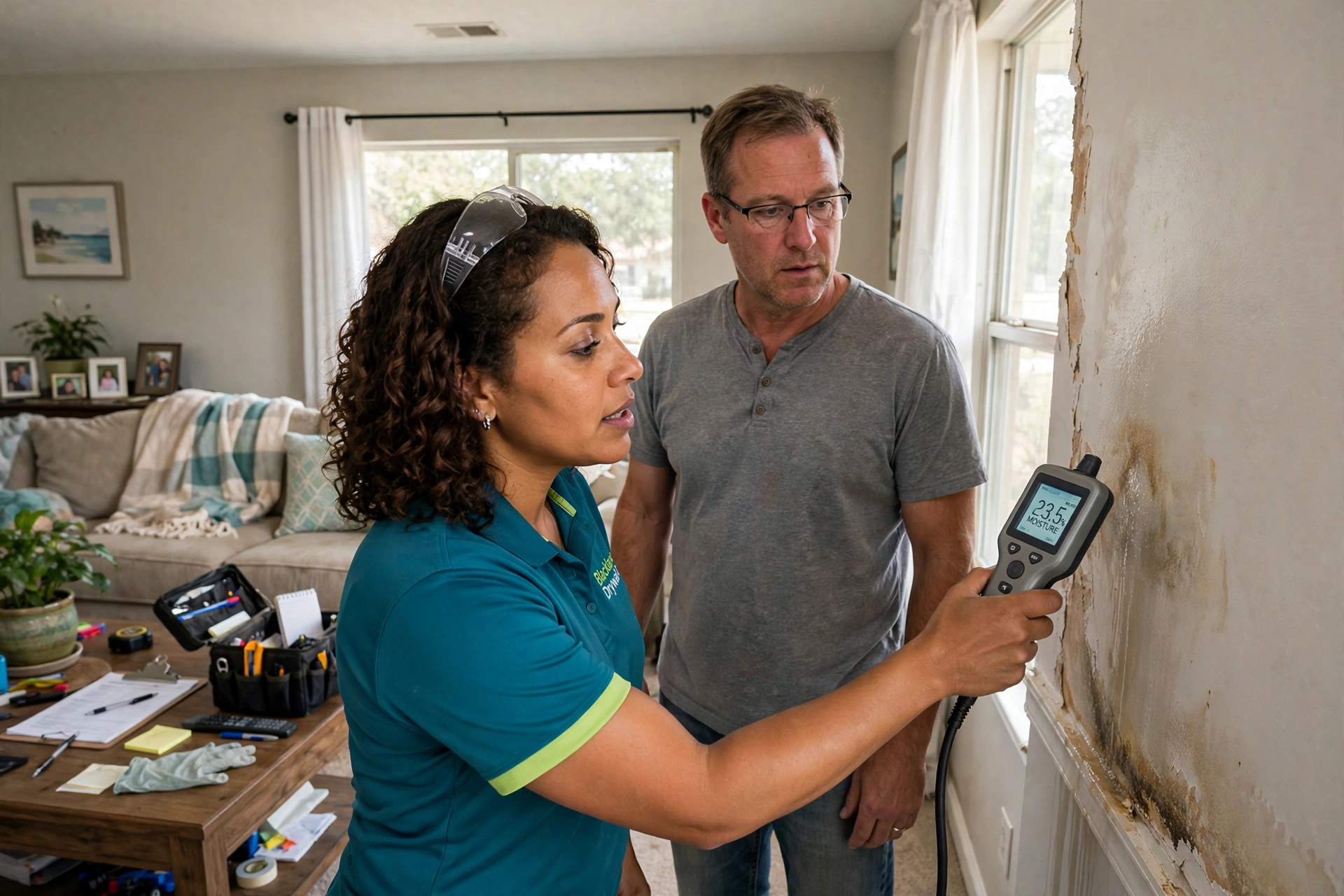
The short answer: press it, look at it, smell it, and check the clock. Drywall that still feels firm and solid can often be dried and saved. Drywall that feels soft, spongy, or crumbly - or that has been wet for more than a couple of days, was soaked by dirty water, or is sagging on a ceiling - needs to come out and be replaced. When in doubt, a pro with a moisture meter can tell you in minutes. Call Blacklands Drywall Co. at (214) 494-8955 and describe what you're seeing.
Why Getting This Call Right Matters
Replace drywall that could have been dried, and you've paid for demolition, new material, and full refinishing you didn't need. Try to save drywall that's actually ruined, and you'll pay twice - once for the patch that fails, and again for the replacement, plus whatever mold grew in the meantime.
This is the single most consequential decision in a water-damage job, and it's the one homeowners get wrong most often - usually by trusting the surface. Drywall lies. The visible stain is almost never the full story, and paint hides everything until the problem is bigger. The five checks below are the same ones professionals run, in the same order, adapted for what you can safely do yourself.
Check 1: The Firmness Test (The Most Important One)
Drywall's job is to be rigid. Water destroys that rigidity from the inside out. So the single most revealing thing you can do is also the simplest: press the damaged area gently with your thumb.
- Firm and solid, like the undamaged wall next to it: the gypsum core is still intact. This drywall is a candidate for drying and saving.
- Soft, spongy, or giving: the core has broken down. It will never be strong again, no matter how dry it gets. This section needs replacement.
- Crumbly or flaking under light pressure: the paper facing and core are both compromised. Replacement - and check how far the damage extends past the crumbly spot.
Test the damaged area and the wall around it, moving outward until the drywall feels normal again. That boundary - where soft becomes firm - is roughly where a professional's cut line will go. Homeowners are consistently surprised by how far past the visible stain the softness extends. Water wicks through drywall paper well beyond what your eyes report.
One caution: don't gouge or punch the wall. A firm press with a thumb tells you everything. If the area is on a ceiling and feels soft or saggy, don't press hard - waterlogged ceiling drywall is heavy, and a saturated section can let go. Ceiling softness is an automatic "call a pro" signal, not a DIY diagnostic moment.
Check 2: What You Can See
Your eyes catch the symptoms; the firmness test catches the disease. Still, visual signs narrow things down fast:
- Yellow or brown staining. A stain alone doesn't condemn the drywall - it's discoloration, and stained-but-firm drywall is often salvageable with drying, sealing, and refinishing. But a stain that keeps growing, or one with darker rings at the edges, means water is still moving. Active water first, cosmetics later.
- Bubbling or peeling paint. Moisture under the paint film pushes it off the surface. Light bubbling over firm drywall can be a dry-and-refinish case. Widespread bubbling usually means the paper facing is saturated - replacement territory.
- Swelling or distortion. Drywall that looks puffy or wavy has absorbed significant water. Swollen drywall rarely returns to flat, and the finish will never look right. Replacement.
- Sagging (ceilings). A ceiling that bows downward between joists is holding water weight. This is both a replacement call and a safety call - it needs professional removal, because that section is coming down one way or another.
- Crumbling edges or visible deterioration. If the drywall is falling apart at the surface, the core is gone. Replacement, no debate.
- Stains that return after painting. The classic sign of a repair done wrong. Paint doesn't fix wet drywall - it seals moisture in and the stain bleeds back through. If a previous paint-over is failing, the drywall underneath was never properly dried or was already ruined.
Check 3: What You Can Smell
Musty, earthy, or damp odors near the damaged area are your nose detecting what your eyes can't: microbial activity in wet material. A musty smell with no visible mold often means mold is growing inside the wall cavity or on the back of the drywall - the side you can't see.
Smell matters for the replacement decision because it signals duration and depth. A wall that smells musty has typically been wet long enough for the "just dry it" window to close. It doesn't automatically mean the whole wall comes out, but it means a professional needs to open a section and look inside before anyone declares the drywall salvageable.
Check 4: The Clock - How Long Has It Been Wet?
Time is the hidden variable in every replacement decision:
- Under 24–48 hours, clean water, drywall still firm: the best case. Professional drying has a strong chance of saving it.
- Several days of wetness: the odds shift. Widely published guidance notes mold can begin growing on wet drywall within 24–48 hours, and the longer saturation continues, the more the gypsum core degrades. Past a few days, replacement becomes the likely call even if the surface looks okay.
- Weeks or unknown duration (the stain you just noticed behind furniture, the slow AC drip): assume the worst until proven otherwise. Long-term wetness almost always means replacement of the affected sections, plus a look at the insulation and framing behind.
This is why "when did you first notice it?" is the first question a pro asks. If you're not sure when the leak started, say so - it changes the inspection approach.
Check 5: What Kind of Water Did It
Not all water damage is equal, and the water's source can decide the question before any test:
- Clean water - burst supply pipe, water heater supply line, rainwater intrusion: drywall can often be dried and saved if caught early and still firm.
- Grey water - washing machine overflow, dishwasher leak, shower drain backup: contains contaminants. Porous drywall soaked with grey water generally needs removal, not drying.
- Black water - sewage backup, rising floodwater: drywall that contacted it must be removed. This isn't a judgment call about the drywall's condition - it's a health call. No drying, no salvaging.
If you know the source was a burst pipe during a Texas freeze, you're in the most salvageable category. If it was floodwater off the street or a sewer backup, replacement isn't a decision - it's the procedure.
What Professionals Check That You Can't
Your five checks get you to a strong preliminary answer. A professional inspection confirms it with tools and access you don't have:
- Moisture meters measure water content inside the drywall and map how far it spread past the visible damage. This is what turns "I think it's about this big" into a measured scope.
- Cavity inspection - sometimes a small exploratory opening - reveals the insulation and framing behind the drywall. Wet insulation holds moisture against everything and usually needs removal; it's also where hidden mold lives.
- Water source verification. Pros confirm the leak is actually stopped before any dry-or-replace decision, because repairing over an active leak fixes nothing.
This is also where the honest "dry it, remove it, or replace it" conversation happens. A good contractor shows you the meter readings and the soft spots and explains the reasoning - you shouldn't have to take the verdict on faith.
The Two Checklists: Save It vs. Replace It
Lean toward drying and saving when ALL of these are true:
- The drywall feels firm and solid under thumb pressure
- The water was clean (supply pipe, rain intrusion - not sewage or floodwater)
- It's been wet less than 48 hours, as far as you know
- No musty smell, no visible mold
- It's a wall, not a sagging ceiling
Lean toward replacement when ANY of these are true:
- The drywall feels soft, spongy, or crumbly
- There's a musty smell or visible mold
- It's been wet for days, or you don't know how long
- The water was grey or black (contaminated)
- It's a ceiling and it's sagging, bowing, or dripping
- A previous paint-over or patch is already failing
When the signs are mixed - firm drywall but a musty smell, for example - that's exactly when the professional inspection earns its keep. Mixed signals mean something is happening where you can't see it.
Ceilings Play by Stricter Rules
Walls can wait a day for an inspection. Sagging ceilings can't. Waterlogged drywall is far heavier than it looks, and a saturated ceiling section can collapse without much warning. If your ceiling is bowing, bulging, or dripping:
- Don't press it, poke it, or try to drain it yourself - puncturing a waterlogged ceiling can release a sudden deluge.
- Move furniture and valuables out from under it.
- Call for emergency assessment.
Ceiling replacement after water damage is common because gravity works against every other option - wet ceiling drywall loses structural integrity faster and more dangerously than wall drywall. Our guide to sagging ceiling drywall from water covers the emergency steps in detail.
What NOT to Do While You're Deciding
- Don't paint over it. The most common and most expensive mistake. Paint seals moisture in, hides the real condition, and guarantees the stain returns - along with a bigger repair bill.
- Don't cut into it blindly. Opening drywall without knowing what's behind it (wiring, plumbing) or without containment can spread mold spores and create hazards. Exploratory openings are a pro's job.
- Don't run a household fan at it and call it done. Surface airflow doesn't dry a saturated wall cavity. Worse, blowing air across mold-suspect drywall can spread spores through the house. Real drying means dehumidification and verified moisture readings - our article on how long wet drywall takes to dry explains why.
- Don't wait for it to "dry out on its own." It won't - not inside a wall cavity. Time converts salvageable drywall into replacement drywall.
Bottom line: Firm, clean-water, recently-wet drywall: dry it. Soft, smelly, long-soaked, dirty-water, or sagging drywall: replace it. Mixed signals: get a moisture-meter inspection before anyone cuts or paints anything.