The short answer: a Rockwall restoration company's published cost page lists drywall repair and replacement in Rockwall at $500–$1,800. Small patches land near the bottom of that published range; whole-wall flood cuts and ceiling replacements land near the top. No honest contractor will give you a firm number without seeing the damage first - the price is decided by how much drywall got wet, whether it can be dried or has to be replaced, and how much finish work the repair needs. If you want a straight answer for your home, call Blacklands Drywall Co. at (214) 494-8955 and describe what you see.
Why There Is No Single Price for Water-Damaged Drywall Repair
"Water-damaged drywall repair" sounds like one job. It isn't. It's a bundle of smaller jobs, and your price depends on which ones your situation needs.
A professional job can include a moisture inspection, drying and dehumidification, cutting out ruined sections, hanging new drywall, taping and mudding seams, matching your wall texture, priming, and painting. A small stain might need only drying and a patch. A soaked wall might need a two-foot flood cut, new insulation, new drywall, and full texture matching across the room. Same search term, completely different jobs.
That's why any price you see online - including the published $500–$1,800 Rockwall range - is a starting point, not a quote. The sections below explain exactly what moves your price up or down, so you can read any estimate with confidence.
The 9 Factors That Decide Your Cost
1. How much drywall is damaged
This is the biggest single driver. A dinner-plate-sized stain on one wall and a fully soaked 12-foot wall are different universes of labor and material. Contractors think in square feet of affected drywall, because every square foot has to be inspected, possibly removed, replaced, finished, and textured.
Damage also spreads. Water wicks outward and upward from the source through drywall paper and into the wall cavity. What looks like a one-foot stain on the surface is often two to three feet of wet drywall behind it. A moisture meter reading - not the visible stain - decides the true size of the job.
2. Whether the drywall can be dried or must be replaced
This is the decision that shapes the whole job, and it's the one Blacklands Drywall Co. is built around: dry it, remove it, or replace it.
Drying is the least expensive path. If drywall is wet but still firm and the water was clean, pros can sometimes dry it in place with airflow and dehumidification, then seal and refinish. Removal and replacement costs more - there's demolition, disposal, new material, and full finishing - but it's the only correct fix for drywall that's soft, crumbly, sagging, or contaminated.
Here's what this means for your wallet: the faster you act, the more likely the "dry it" option stays on the table. Drywall that could have been dried on day one often has to be cut out by day seven. Waiting doesn't just risk mold - it converts a cheaper repair into a more expensive replacement.
3. Wall versus ceiling
Ceiling drywall repair generally costs more than wall repair for the same square footage. The reasons are physical: working overhead is slower, sagging waterlogged ceiling drywall is heavy and dangerous to remove, and gravity means ceiling damage often involves a larger affected area than the stain suggests - water spreads across the ceiling plane before it shows.
A ceiling repair also tends to need more extensive texture matching, because ceilings catch light in ways that expose every flaw in the finish. If your ceiling has popcorn texture, read our companion article on popcorn ceiling water damage - matching that texture is a specialized skill that affects both price and result.
4. What kind of water caused the damage
Restoration pros classify water in three categories, and the category changes the job:
- Clean water (supply line, burst pipe): the simplest case. Drywall can sometimes be dried and saved.
- Grey water (washing machine, dishwasher, shower drain): contains contaminants. Porous materials like drywall usually need removal, not drying.
- Black water (sewage, floodwater): drywall that touched it must be removed. No exceptions, no drying - it's a health call, not a cost call.
If your drywall was soaked by a burst supply pipe during a Texas freeze, you're in the best-case category. If it was floodwater off the street, the drywall is coming out regardless of how it looks.
5. Texture and finish matching
An invisible repair costs more than a visible one, and the difference is all in the finishing. Matching orange peel, knockdown, or smooth finishes - then priming and painting to blend - is skilled hand work. It takes a separate visit after the mud dries, and it can't be rushed.
This is also where cheap quotes cut corners. A low bid that skips proper texture matching leaves you with a smooth patch in the middle of an orange-peel wall - a repair you'll stare at for years. When comparing estimates, check that texture matching and paint are itemized, not assumed.
6. What's behind the drywall
Drywall is the surface; the wall cavity is the hidden cost. Wet insulation behind the drywall almost always needs to come out - it holds moisture against framing and feeds mold. Framing that stayed wet needs drying time before anything gets sealed up. In older Rockwall homes around areas like downtown and the older neighborhoods off Goliad, we also find surprises: older wiring, previous patch jobs, or framing quirks that slow the work.
A good estimate accounts for the cavity, not just the surface. A quote that prices only the visible drywall is either incomplete or about to grow.
7. Mold
If mold has started - and widely published guidance notes it can begin within 24–48 hours on wet drywall - the job changes. Suspected mold means containment, careful removal, and making sure the cavity is dry before new drywall goes up. Blacklands Drywall Co. doesn't sell mold remediation as a standalone service; what we do is identify suspected mold during inspection, handle the drywall side correctly, and tell you plainly when a situation needs a mold assessment before we seal the wall.
Mold adds cost because it adds steps and caution. The cheapest way to avoid the mold premium is speed: deal with wet drywall inside the first day or two.
8. Timing, access, and emergency service
After-hours emergency calls cost more than scheduled work - that's true in every trade. Access matters too: a straightforward ground-floor wall is faster than a vaulted ceiling 16 feet up, or a wall behind built-in shelving that has to be worked around. If furniture needs moving and the room needs containment sheeting, that's labor time on the invoice.
9. Who does the work
A water-damaged drywall specialist and a general handyman will price the same stain differently because they're pricing different jobs. The specialist's estimate includes moisture mapping, the dry/remove/replace decision, proper drying, and texture matching. The cheaper quote often prices a cosmetic patch - which fails when the wet drywall behind it keeps deteriorating, and then you pay twice.
The most expensive repair is the one you pay for twice. When quotes differ wildly, the difference is usually scope, not greed. Ask each contractor exactly what's included (the checklist in the estimate section below helps).
What's Actually Included in a Professional Job
To understand pricing, it helps to see the full sequence a proper job follows:
- Inspection and moisture mapping. Meters find how far water traveled past the visible stain - this defines the real scope.
- Water source confirmation. Repairing drywall over an active leak fixes nothing. The source must be stopped first.
- Drying and dehumidification. Air movers and dehumidifiers dry the cavity; readings verify it's actually dry, not just surface-dry.
- Containment and removal. Damaged sections come out in clean lines (often a "flood cut" - a straight horizontal cut, typically 2 feet up from the floor, which makes replacement efficient). Debris is contained and removed.
- Cavity work. Wet insulation out, framing dried, everything verified dry before close-up.
- Replacement. New drywall hung, seams taped and mudded.
- Texture matching. Your wall's texture - orange peel, knockdown, smooth - replicated on the new section.
- Prime and paint. Sealed, primed, and painted to blend with the surrounding wall.
- Cleanup. Dust contained during work, area cleaned after.
When you see an estimate, check it against this list. Anything missing is either a shortcut or a surprise waiting in a change order.
Three Typical Job Scenarios (Illustrative - Not Quotes)
These aren't prices. They're patterns, so you can recognize which one matches your situation and understand why it costs what it does relative to the others.
Scenario A: the small ceiling stain. A slow AC drain-line drip leaves a foot-wide brown stain on a bedroom ceiling. The drywall is firm, the water was clean, and you caught it early. The job: verify the drain line is fixed, dry the area, seal the stain, patch and texture a small section, repaint. This is the low end of the published Rockwall range - minimum labor, minimum material.
Scenario B: the flood cut. A supply line bursts under a kitchen sink overnight (a classic Texas freeze scenario). By morning, the bottom two feet of drywall along one wall is soaked, baseboards are swollen, and the insulation behind is wet. The job: flood cut along the wall, remove baseboards and wet insulation, dry the cavity and framing, hang new drywall, tape and mud, match texture, prime, paint, install new baseboards. Mid-range - the labor is in the multi-step sequence and the finishing.
Scenario C: the sagging ceiling. A roof leak during spring storm season soaks a section of living-room ceiling. The drywall is sagging and heavy with water. The job: safe removal of the compromised section, cavity inspection and drying, new drywall hung overhead (slower work), full texture matching across a visible ceiling plane, prime and paint. High end of the range - overhead work, larger area, demanding finish.
Notice what moves each scenario: square footage, dry-versus-replace, ceiling-versus-wall, and finish complexity. That's the pricing logic behind every honest estimate.
Repair vs. Replace: Which Costs More?
Replacement costs more upfront - more labor, more material, more finishing. Repair (drying and patching) costs less. But the comparison that matters is correct repair versus repeat repair.
Patching over drywall that's still wet, soft, or moldy doesn't save money. The patch fails - tape bubbles, texture cracks, stains bleed back through paint - and you're paying for the job again, this time with more damage than before. A replacement done once is cheaper than a patch done twice.
The honest question isn't "repair or replace, which is cheaper?" It's "what does this specific drywall actually need?" That's a moisture-meter question, not a price question. Our article on how to tell if drywall needs replacement walks through the tests.
Does Homeowners Insurance Cover Water-Damaged Drywall?
Often, but it depends on the cause - and the cause decides both coverage and your out-of-pocket math:
- Sudden and accidental events (burst pipe, appliance supply-line failure): typically covered. You pay your deductible; insurance covers the rest of the repair.
- Slow leaks over weeks or months: often denied. Insurers treat long-term leaks as maintenance issues.
- Floodwater from outside: not covered by standard homeowners policies - that's separate flood insurance.
One practical tip: if you think you'll file a claim, document before repairs start. Photos of the damage, the water source, and the affected area help your adjuster. Don't wait for the adjuster to start emergency drying, though - insurers expect you to mitigate further damage. Our full guide to insurance claims for water-damaged drywall covers the documentation that actually helps.
And do the deductible math: if your deductible is $2,500 and the repair is a small patch job, filing may not make sense. If it's a multi-wall flood cut, it very well might.
How to Get an Accurate Estimate in Rockwall
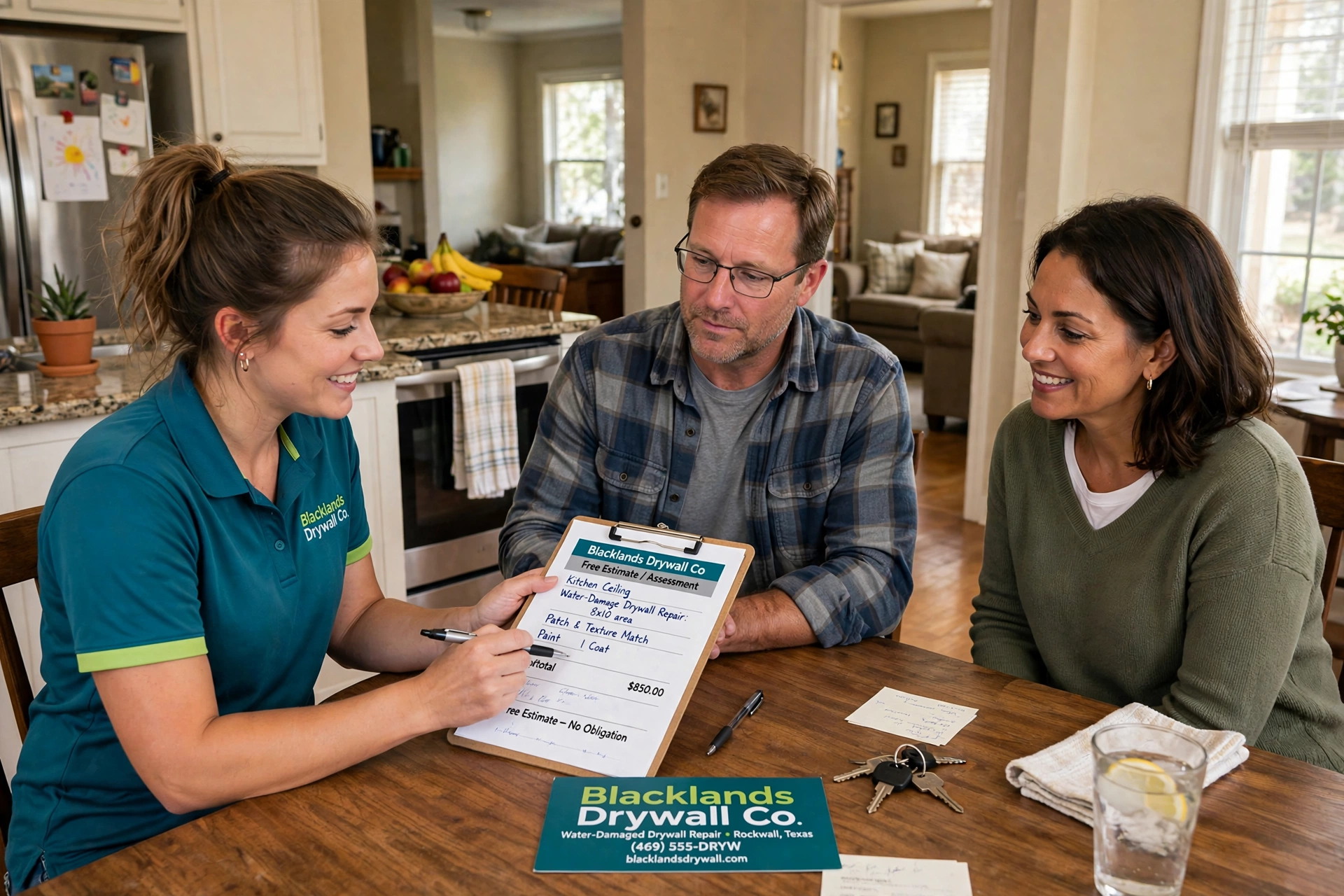
A useful estimate is specific. When Blacklands Drywall Co. - or any contractor - prices your job, here's what the estimate should spell out:
- Measured scope: how many square feet of drywall are affected (from meter readings, not eyeballing the stain).
- The decision: dry, remove, or replace - stated explicitly, with the reasoning.
- Cavity work: whether insulation removal and cavity drying are included.
- Finish work: texture matching type and whether prime/paint are included.
- Timeline: how many visits (drying and mudding each need their own time).
- What's excluded: so there's no surprise change order later.
Questions worth asking any contractor:
- How do you determine whether drywall can be dried or must be replaced?
- Do you check moisture behind the visible damage?
- Is texture matching included, and what texture will you match?
- How many visits will this take, and why?
- What happens if you open the wall and find more damage?
Red flags: a firm price quoted from photos alone, no mention of moisture testing, texture and paint "included" without specifics, pressure to decide on the spot, or a bid dramatically lower than others with the same vague scope. The cheapest bid with undefined scope is the most expensive bid you'll ever accept.
What Keeps Your Cost Down
You can't control the price of materials, but you control the three things that matter most:
- Speed. The 48-hour mold window is also a cost window. Fast action keeps the "dry it" option alive and keeps mold out of the equation. Every day of waiting converts dryable drywall into replaceable drywall.
- Stop the source first. A $0 fix - turning off the water, clearing the AC drain line - prevents the job from growing while you arrange the repair.
- Don't paint over it. Paint over a water stain hides the symptom while the damage continues. The stain bleeds back, the drywall keeps weakening, and the eventual repair is bigger. It's the most expensive "saving" in home repair.
Bottom line: Water-damaged drywall repair in Rockwall runs from a few hundred dollars for a small patch to the top of the published $500–$1,800 range for major replacements - and the number is decided by square footage, the dry-or-replace decision, and finish complexity. The two things that keep your cost lowest are speed (act inside the first 48 hours) and scope honesty (an estimate that itemizes the real work).